
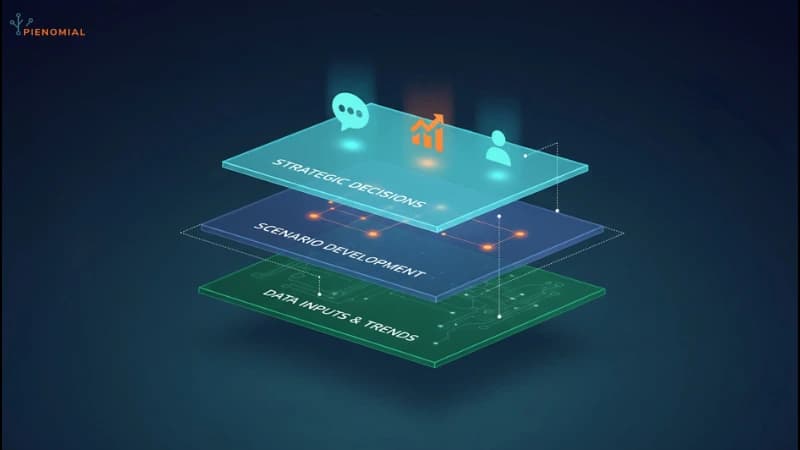
In the pharmaceutical industry, the only certainty is uncertainty. Yet, decisions involving billions of dollars and years of development are often made based on linear assumptions that fail to account for the dynamic reality of the market. At Pienomial, we see a shift away from rigid forecasting towards adaptive planning.
Strategic Uncertainty in Life Sciences Development
The path to approval and commercial success is rarely a straight line. Modern life sciences strategy must navigate a web of variables that are constantly in flux.
A. Multiple possible trial and market outcomes
A single clinical trial can yield a spectrum of results from a resounding success to a mixed outcome that requires a subgroup analysis. Simultaneously, the market itself is moving; a competitor might fail, or a new standard of care might emerge before your asset even reads out.
B. Shifting competitive and regulatory landscapes
Regulatory goalposts shift as agencies adapt to new science, while competitors constantly adjust their timelines and claims. Relying on a static snapshot of the landscape is a recipe for strategic surprise.
C. Need to plan beyond a single “best-case” path
Too often, teams optimise for the "happy path", assuming perfect recruitment, clear efficacy, and favourable pricing. However, resilience requires planning for the "what ifs."
What Scenario Mapping Means in Life Sciences
This is where scenario planning in healthcare becomes indispensable. It is not about predicting the future; it is about rehearsing for it.
A. Evaluating multiple evidence-driven futures
Scenario mapping involves constructing detailed, plausible future states based on current evidence. It forces teams to ask: "If Competitor X launches early with a broad label, what is our counter-move?"
B. Testing strategic assumptions against data
It moves strategy from "gut feel" to data validation. By rigorously testing assumptions against different scenarios, teams can identify which parts of their strategy are robust and which are fragile.
C. Preparing for risk and opportunity simultaneously
Effective scenario planning in healthcare is not just defensive. It also highlights opportunities, such as a market gap created by a competitor’s safety signal that would otherwise go unnoticed in a standard forecast.
Limitations of Traditional Strategic Planning
Despite the volatility, many organisations cling to outdated planning models that leave them vulnerable.
A. Linear plans that ignore uncertainty
Traditional plans often force a single narrative, treating risks as footnotes rather than central drivers. This linearity creates a false sense of security that crumbles when the first disruption hits.
B. Limited ability to compare alternative paths
Without scenario planning in healthcare, it is difficult to compare the long-term value of different strategic options side-by-side. Teams struggle to weigh the trade-off between a high-risk, high-reward aggressive timeline and a slower, more conservative approach.
C. Disconnected insights across teams
Often, the commercial team plans for one future while clinical operations plans for another. This disconnect leads to misaligned resources and conflicting priorities.
How Scenario Mapping Improves Strategic Decisions
When teams realise how scenario mapping improves pharma strategy, the quality of decision-making transforms.
A. Clarifies trade-offs between speed, risk, and differentiation
Mapping allows leaders to visualise trade-offs explicitly. It becomes clear, for instance, that accelerating a trial by six months might increase the risk of a narrow label, a trade-off that can then be debated and decided upon consciously.
B. Aligns clinical, regulatory, and commercial priorities
Scenario planning in healthcare acts as a unifying language. When Clinical, Regulatory, and Commercial teams co-create scenarios, they align on a shared vision of success and the contingencies required to achieve it.
C. Supports a proactive rather than a reactive strategy
Instead of scrambling to react to a competitor’s press release, teams with a scenario map have already prepared their response. They shift from fire-fighting to fire prevention.
Role of Evidence Platforms in Scenario Mapping
To be effective, scenarios cannot be static slides; they must be living, data-driven ecosystems. This is where platforms like KnolScapes play a pivotal role.
A. Bringing structured evidence into strategic discussions
Modern platforms ingest real-time data registries, publications, and regulatory updates to ground scenarios in reality. This prevents "science fiction" planning and ensures every scenario is tethered to actual market signals.
B. Enabling scenario comparisons using real data
Technology allows for dynamic toggling between scenarios. Teams can visualise how a change in a single variable, like a competitor’s enrollment delay, ripples through the entire life sciences strategy.
C. Supporting cross-functional alignment
By centralising data in a shared view, evidence platforms ensure that every stakeholder is looking at the same map, fostering deep organisational alignment.
Conclusion
The era of the five-year linear plan is over. To navigate the complexities of modern development, scenario planning in healthcare is no longer a luxury; it is a survival skill. By anticipating multiple futures, teams can navigate uncertainty with confidence.
Ready to map your path to success? Learn how Pienomial helps teams evaluate scenarios with evidence-backed clarity, turning strategic uncertainty into your competitive advantage.