Key Takeaways :
Pharma competitive intelligence and pharma market monitoring are no longer functions that can be adequately served by quarterly reports, consultant summaries, or generic AI search tools. The speed of signal generation in modern pharmaceutical markets , across clinical development, regulatory decisions, pricing, and HTA , requires a continuous, governed, AI-powered intelligence infrastructure.
Knolens platform delivers exactly this: a life sciences AI platform where competitive signals are continuously ingested, structured, attributed, and made available to decision-makers in a traceable, audit-ready format. For pharma teams where strategic timing determines commercial outcomes, closing the gap between signal and decision is no longer optional.
In pharmaceutical development and commercialisation, strategic advantage is measured in months. A competitor's Phase III readout, a surprise regulatory approval in your therapeutic area, or an HTA authority shifting its evidence requirements , these events can reshape a multi-billion-dollar market in weeks[1]. The quarterly competitive intelligence report that arrives three months after the signal appeared is not intelligence. It is history.
Pienomial's Knolens platform addresses this fundamental problem in pharma market monitoring: the gap between when a competitive signal becomes available and when it reaches the decision-makers who need to act on it. Closing this gap , from months to hours , is the core value proposition of AI-powered competitive intelligence in life sciences.
The Five Signal Domains That Define Pharma Competitive Landscape
Pharma competitive intelligence is not a single data stream. It is the synthesis of signals across five distinct domains, each with different update frequencies, different strategic implications, and different requirements for analytical depth.
Pipeline milestones , Phase transitions, trial initiations, interim readouts, regulatory submissions , are the most time-sensitive signals. A competitor advancing to Phase III in your indication changes your market access timeline and your clinical differentiation strategy. Pricing and reimbursement decisions by national health technology assessment bodies are slower-moving but strategically decisive for commercial planning. Regulatory approvals, label expansions, and safety communications directly affect your competitive positioning and may require rapid regulatory response.
Mergers, acquisitions, and licensing deals are intelligence signals as much as corporate events , they reveal where major players believe the value will be in three-to-five years. And publication activity, including conference presentations and preprints, signals where the scientific consensus is moving before it reaches formal regulatory guidance. Pharma market monitoring that covers all five domains continuously , not quarterly , gives strategy and portfolio teams a structural informational advantage.
Why Quarterly CI Reports Are a Strategic Liability
The quarterly competitive intelligence report has been the standard delivery format in pharma for decades[2]. It is also, structurally, a guarantee of delayed intelligence. By the time a quarterly report is researched, written, reviewed, and distributed, the market has already moved. Decision-makers are acting on information that was current four to twelve weeks ago.
Beyond the latency problem, quarterly reports suffer from coverage gaps, analyst inconsistency, and a complete absence of traceability. When a strategic decision is challenged , by a board, an investment committee, or a regulatory body , the ability to trace a competitive claim back to its primary source is essential. A PDF summary prepared by a consultant provides no such chain of evidence.
AI expert intelligence , where competitive signals are continuously classified, attributed, and stored in a governed knowledge layer , replaces the quarterly report not with a faster report, but with a fundamentally different intelligence architecture.
AI as Signal Processor: From Raw Data to Actionable Intelligence
The volume of competitive signal data available in pharmaceutical markets is not the constraint. The constraint is the ability to filter, structure, and contextualise signals in a way that makes them actionable. A press release announcing a Phase II initiation is a raw signal. When it is classified by indication, mechanism, endpoint, patient population, and competitive proximity to your own programme, it becomes intelligent.
This is the core function of an enterprise intelligence platform applied to pharma competitive intelligence: transforming the continuous flow of raw signals , publications, filings, regulatory documents, conference abstracts, payer decisions , into a structured, searchable, and continuously updated knowledge layer. Pharma market monitoring at this level of sophistication requires AI expert intelligence built on domain-specific ontologies, not generic news aggregation.
Explainable AI models are particularly important in this context. When a competitive intelligence output influences a portfolio decision or a market access strategy, the reasoning behind the analysis must be auditable[3]. Teams need to be able to answer: what signals triggered this assessment, and where did they come from?
The 3–12 Month Strategic Lead Time AI Creates
The strategic value of AI-powered pharma competitive intelligence is not simply knowing what is happening today. It is detecting emerging trends and patterns early enough to act on them before they become constraints. A platform that processes clinical trial registrations, early-phase results, regulatory guidance updates, and HTA precedent decisions continuously can surface signals that indicate where a therapeutic area is moving 3 to 12 months before those signals crystallise into public market events.
This lead time has direct commercial value. Earlier awareness of a competitor's Phase III endpoint selection allows your clinical team to adjust your protocol before your own trial is locked. Earlier intelligence on HTA authority evidence preferences allows your HEOR team to design studies that will meet those standards. Earlier detection of a competitor's pricing strategy allows your market access team to prepare a differentiated value narrative before payer negotiations begin.
Life sciences market intelligence at this depth requires more than a search engine. It requires a governed, domain-specific knowledge layer that accumulates and structures evidence over time , an enterprise knowledge layer for AI that serves as an institutional memory as well as a signal detection system.
Governed AI vs Generic LLM Search for Competitive Intelligence
Generic LLM-powered search tools can retrieve and summarise competitive information. They cannot guarantee the accuracy of that information, trace it to a primary source, or ensure that your proprietary competitive strategy does not leak to third-party model providers[4]. In competitive intelligence, where the sensitivity of the information is high and the cost of an error is a misdirected strategic decision, this is an unacceptable risk profile.
A trusted enterprise AI architecture for pharma competitive intelligence must operate within your own environment, never exposing queries or derived intelligence to external APIs. It must attribute every competitive claim to a specific, verifiable source. And it must provide governance controls that allow you to manage who sees what intelligence and under what conditions.
The AI authoring platform capabilities that Knolens brings to competitive intelligence , generating structured, traceable competitive briefs from the knowledge layer , allow teams to move from signal detection to distribution-ready intelligence in hours rather than days.
Building a Living Competitive Intelligence Layer
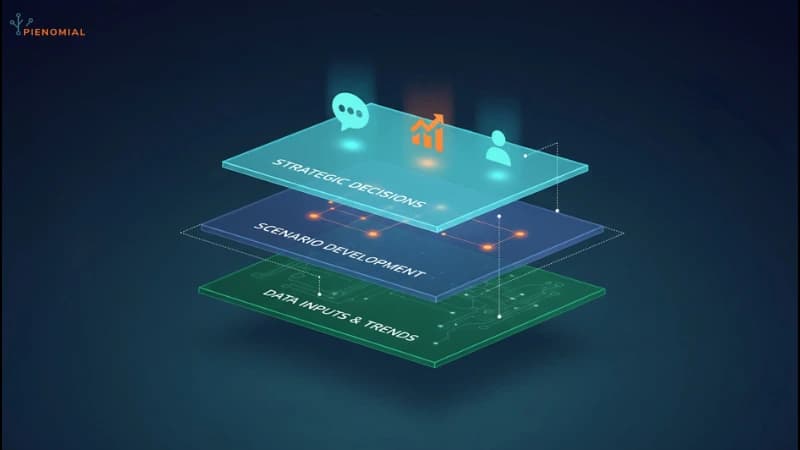
The shift from quarterly reports to continuous pharma market monitoring requires a change in infrastructure, not just tooling. A living competitive intelligence layer is built on six components: a continuously updated data ingestion pipeline covering all five signal domains; a classification and enrichment layer that structures signals by indication, mechanism, regulatory status, and competitive proximity; a persistent knowledge graph that accumulates and contextualises intelligence over time; an alert system that surfaces high-priority signals to relevant teams in near real-time; an authoring layer that generates traceable, structured intelligence outputs; and a governance framework that manages access, attribution, and audit requirements.
This is what distinguishes a life sciences AI platform from a research tool. The difference is not the quality of individual outputs , it is the architecture that makes intelligence continuous, traceable, and institutionally persistent.
References
[1] MathCo (2025). Pharma Competitive Intelligence: Why the Industry Is Still Missing the Signals That Matter. https://mathco.com/blog/pharma-competitive-intelligence-signals-that-matter/
[2] Evaluate Consulting (2025). Competitive Intelligence in Pharma: Consultant Insights. https://www.evaluate.com/interview/consultant-insights-competitive-intelligence-pharma/
[3] NIST (2023). Artificial Intelligence Risk Management Framework (AI RMF 1.0). National Institute of Standards and Technology. https://www.nist.gov/publications/artificial-intelligence-risk-management-framework-ai-rmf-10
[4] Farquhar, S. et al. (2024). Detecting hallucinations in large language models using semantic entropy. Nature, 630, 625–630. https://www.nature.com/articles/s41586-024-07421-0